 F4LUFTBILDER
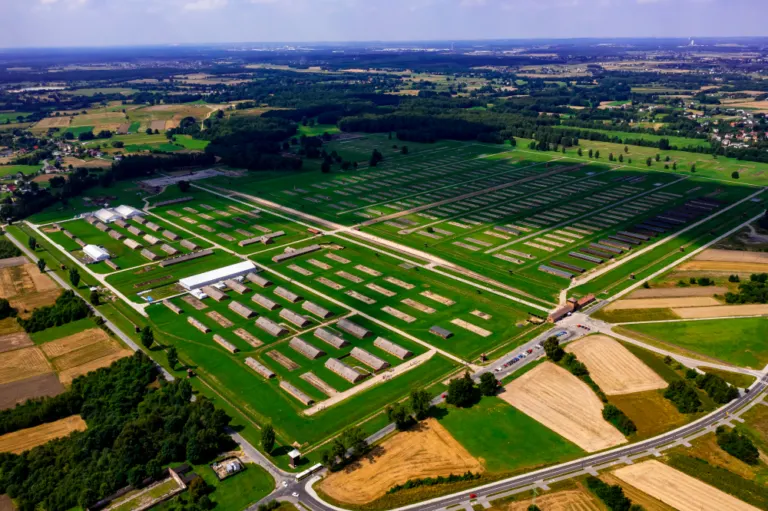


Arranging Auschwitz-Birkenau spatially
An aerial view of today's Auschwitz-Birkenau memorial shows paths, preserved buildings and traces of structures. It provides an overview of the site of the former German National Socialist concentration and extermination camp in occupied Poland. Anyone interested in the history of this place needs historical sources in addition to spatial orientation. The names, memories and testimonies of the people who were deported to Auschwitz give the visible place its meaning.
The site of today's memorial
At first glance, straight lines, large distances and recurring shapes are noticeable in the aerial photos. Some buildings are clearly visible. Only traces of others remain on the ground. From above, two areas may look similar, even though they had very different functions during storage. If you would like to name an individual location, you should first look for it in an explained map of the memorial. This is particularly important with a narrow image section that cuts off known reference points at the edge.
A photo taken today captures a time after the liberation. The conditions under which people arrived here, how they were treated and what they experienced can hardly be understood from today's appearance alone. Well-maintained paths and green spaces are part of the memorial's presence. A caption should explicitly state this time distance. This is particularly important for readers who also see historical photographs in the same context.
Auschwitz and the history of the persecuted
The German National Socialists built Auschwitz in occupied Poland in 1940. The camp complex included, among others, Auschwitz I and Auschwitz II-Birkenau. Birkenau became a central place for the murder of European Jews. The people persecuted and murdered in Auschwitz also included Poles, Sinti and Roma, Soviet prisoners of war and members of other groups. Carefully identifying the locations and the different persecution stories is the responsibility of every publication.
The memorial provides historical introductions and materials. To prepare for a visit, you can first look at a historical map and then look for the same area in a modern-day image. A further question concerns the people from whom sources from this area have come down to us. Dealing with a path or a building leads back to the people whose lives, persecution and murder are reported there.
What a caption can do
A caption can include the name of the memorial, the recognizable section and the classification as today's view. If the exact section is unclear, the description should stick to what is actually visible. A supposedly precise building name is of little help if it refers to the wrong place. The timing is equally important. A historical photo from the camp period and a drone photo taken later answer fundamentally different questions about the site.
Anyone who uses an aerial photo in a teaching unit can connect the observation with a specific task. The learners look for roughly the same route on the photo and map and note what information the legend conveys. A testimony can then be added in which a person talks about their experience in that place. The order leaves room for the boundaries of photography and for an encounter with the source in its own context.
Sources for in-depth study
For the aerial photographer at this location, it is also important to decide what explanation the image needs. A present-day panorama can provide orientation, but a historical statement should be based on comprehensible sources. For further work, the historical introduction to the Auschwitz-Birkenau Memorial offers a starting point. It places the camp complex in the history of the Shoah and makes it possible to return from looking at the site to specific historical questions.