 F4LUFTBILDER
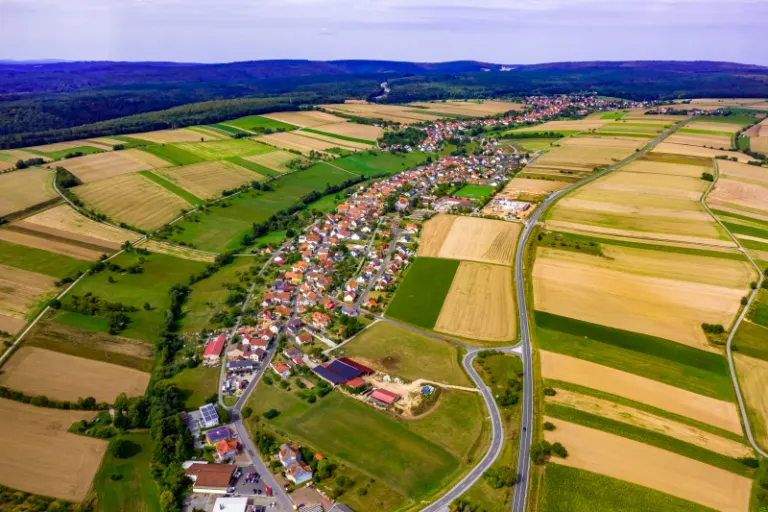


Bischbrunn at the transition to the Spessart Forest
Bischbrunn follows a long line with its houses. Between the town and the forest lie narrow, differently colored fields, the boundaries of which clearly stand out. An overview from a bird's eye view shows the connection that a shot of the street breaks down into many individual views.
A village between strips of fields
In Bischbrunn the edge of the forest marks the transition into the Spessart. It forms a longer, connected border than the small hedges that separate individual fields from each other.
The center of a town can often be recognized from the air by the intersection of several streets. These lines diverge towards the open landscape, the properties become longer and the distances between the houses become larger. Anyone who chooses an image for a location portrait can pay attention to these transitions. A motif with a piece of the surrounding area tells where the place is. A narrower shot, on the other hand, gives people who live or have lived here more opportunities to find familiar buildings in the picture.
Field boundaries as a benchmark
From a greater height, the field appears to be an orderly floor plan. A closer look shows how the paths change direction at curves, embankments and property boundaries. When selecting images, it is helpful to preserve at least one of these transition points. It turns a colored area into a piece of actually used landscape. For an article about the surrounding area, even the inconspicuous edge of a field can explain more than a wide section that only shows numerous plots as small spots.
What the treetops reveal
A forest changes the view of every structure and every path that lies on its edge. From one side the treetops cover the lower area, from another a small gap opens. Photos in which the boundary between open space and vegetation can be clearly seen are particularly interesting. They explain which parts of a motif are visible. In a description, it is possible to distinguish precisely between the section depicted and the terrain hidden by the foliage.
Warm tones within the series
To switch between two of the 5 aerial photos, shot 4 and shot 3 can be called up directly in the gallery. In the second view, warm reds and browns have more weight than in the first. Red-brown and yellowish areas are particularly noticeable next to cooler surfaces. What is interesting when comparing is whether they are concentrated on a single object or appear spread out across the entire view.
Shot 1 and Shot 5 are among the views from September 3, 2020. According to the camera's time information, there is about a minute between the two images. The exposure time was 1/500 second for the first of the images mentioned and 1/400 second for the second.
A townscape for chronicle and community
Anyone who wants to show their family their place of origin often first looks for their own house in the aerial photo. When publishing for the community, the task is different. Even a non-local reader should be able to easily follow the path from the core to the landscape. An aerial photographer can start from the same terrain for both purposes and choose the section differently. What counts for the family portrait is the recognizability of a specific property. When it comes to the townscape, however, it is worth adding a little more surrounding area, even if it means that the individual roof appears smaller.
Related motifs in the aerial photo archive
Two additional views can be used in the archive for comparison. The first can be found under Esselbach. Esselbach stretches over moving terrain in which arable land and forest come close to the houses. The second belongs to the article Arnstein. Near Arnstein in Lower Franconia, residential areas, larger commercial roofs and open fields merge into one another.