 F4LUFTBILDER
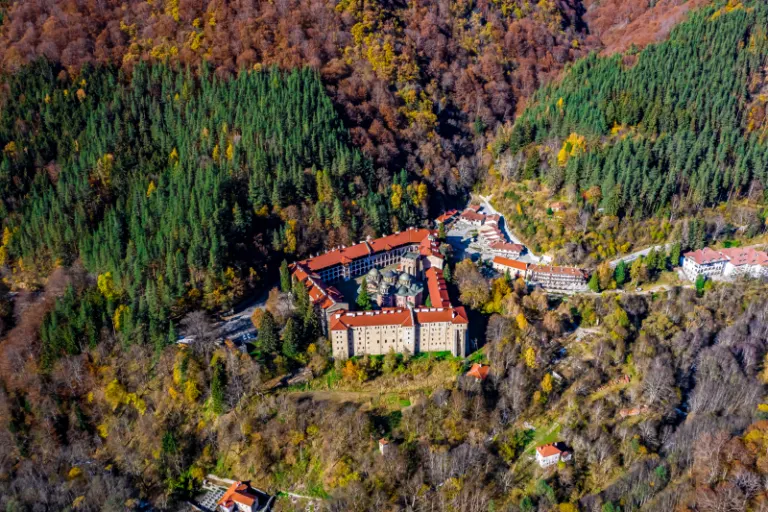


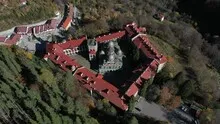
The courtyard of the Rila Monastery
In the Rila Monastery, the red roofs form an almost closed enclosure around the courtyard and the church. Forested mountain slopes rise all around. The steeper view reveals the order of the monastery, the wider perspective reveals its remote location in the Bulgarian mountains.
Monastery courtyard and mountain valley
At the Rila Monastery, the closed exterior building almost inevitably draws the eye into the courtyard. The mountains in the wider area give this concentrated building structure a second dimension.
In a courtyard, the relationships between buildings change. What appears from the outside to be a single long building can actually wrap around several open areas. In a steep aerial view, the passageways, the corners and the orientation of the adjacent roofs become understandable. For a caption, a specific reference to the visible side of the courtyard is often more helpful than a list of all the buildings. This means the viewer can recognize the spatial connection themselves and find it again in other images.
Church building and neighborhood
A church can often be identified in the townscape by its height. In an aerial view, the arrangement of the roof surfaces also helps. It shows the length of the ship, the orientation of the building and its relationship to paths and adjacent areas. A particularly clear angle is where the tower only covers a little of the rest of the building. To create a portrait of the location, some of the surroundings can be included in the picture. Only it turns the individual church building into a concrete place with a neighborhood.
Recognize the shape of the valley area
Two different narrative directions emerge along a valley and across it. The longitudinal view leads into the distance and shows what is arranged one behind the other. Looking sideways, the width of the valley floor and the rise on either side become clearer. Which view is convincing depends on the question asked of the image. For a description of the location, a lateral view is often productive. For a stretch along a route, the longitudinal view gives the viewer a direction to follow across multiple subjects.
The color effect of two views
For a direct image comparison, use shot 2 and shot 5 from the gallery with 14 aerial photos. The colors appear more reserved in the first photo. In the second, individual colors stand out more clearly from each other. In the more reserved view, outlines and gradations of brightness are more important. In the stronger version, even a single colored surface can become the starting point for viewing.
According to camera data, Shot 1 and Shot 14 were taken on November 12, 2020. There is a gap of around 6 minutes between the two pictures. ISO 100 and an exposure time of 1/500 second are recorded for both files.
A moving view is also available. Under Aerial videos you can find the clip “Rila Monastery in Bulgaria from the air”. The linked preview leads to inclusion in the aerial photographer's portfolio on Adobe Stock.
Prepare a cityscape for readers
A local person will often recognize a street by a single roof. Anyone who sees the city for the first time needs more clues. For a city guide, a short caption can best start at a visible intersection and lead the eye from there to the actual subject. The aerial photographer sees the surroundings outside the section while taking the picture. Readers will later only see the published area. Especially when cropping later, it is worth checking whether the connection described can still be seen in the final image.
Related motifs in the aerial photo archive
The article Biserica Sfânta Maria offers another perspective. The Biserica Sfânta Maria in Moldova is located in an ensemble of elongated roofs, interior surfaces and paths. In the gallery Bulgaria – Bansko there is a different focus. In the series from around Bansko, forested mountain ridges reach to the horizon.