 F4LUFTBILDER
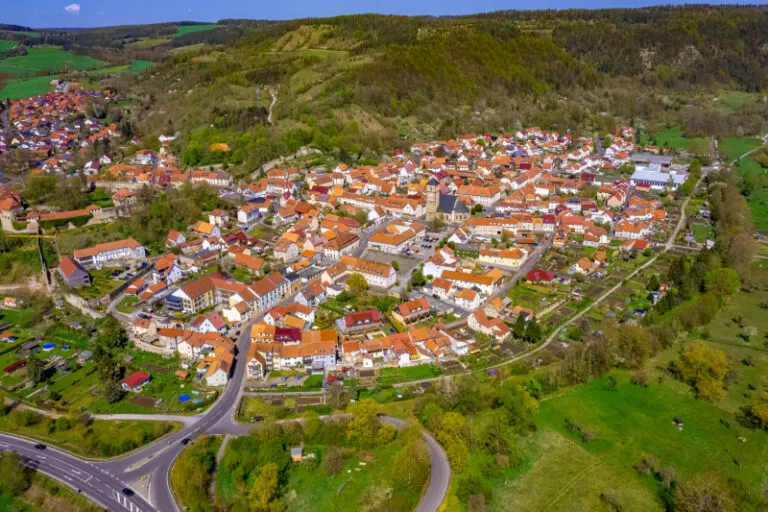


Creuzburg around the castle hill
In Creuzburg the castle sits directly above the roofs of the town. In the narrower image, an enclosed courtyard is visible; in the wider view, the overgrown slope in front of it appears. A series of images can first anchor the castle in the townscape and then show its own architectural form.
The courtyard on the castle hill
In Creuzburg, the castle hill contrasts the small-scale town center with a large building. A view in which neighboring houses and the castle courtyard can be compared at the same time is particularly understandable.
The system can be told from two distances. The overview first clarifies how much space the building takes up on its hill or on the bank. The view then turns to a characteristic corner, the transition between two wings or the opening to a courtyard. This order is clear for an editorial article because readers can find the detailed section on the overview image. This is particularly helpful when multiple towers or wall edges obscure each other in a single view.
Courtyards and entrances
In a courtyard, the relationships between buildings change. What appears from the outside to be a single long building can actually wrap around several open areas. In a steep aerial view, the passageways, the corners and the orientation of the adjacent roofs become understandable. For a caption, a specific reference to the visible side of the courtyard is often more helpful than a list of all the buildings. This means the viewer can recognize the spatial connection themselves and find it again in other images.
How the place changes from the inside out
The center of a town can often be recognized from the air by the intersection of several streets. These lines diverge towards the open landscape, the properties become longer and the distances between the houses become larger. Anyone who chooses an image for a location portrait can pay attention to these transitions. A motif with a piece of the surrounding area tells where the place is. A narrower shot, on the other hand, gives people who live or have lived here more opportunities to find familiar buildings in the picture.
Shades of green in the image
If you browse through the 7 aerial photos, you can stay at shot 7 and shot 5 for a comparison. In the first image, green areas make up a smaller part of the section than in the second. It's worth tracking the green areas individually. Only in connection with neighboring forms does it become clear what is in the foreground and what belongs to the more distant surroundings.
For Shot 1 and Shot 7, the same day is noted in the image files, April 19, 2020. The recording times recorded are about 3 minutes apart. The exposure time was 1/500 second for the first of the images mentioned and 1/640 second for the second.
A moving view is also available. The clip “Creuzburg” can be found under Aerial videos. The linked preview leads to inclusion in the aerial photographer's portfolio on Adobe Stock.
Communicate architecture and location together
Anyone who has visited a building themselves often remembers the entrance and the first view upwards. In the aerial photograph, these exact areas can disappear behind a roof or a wall. A suitable caption helps to connect the tour experienced with the spatial overview. For an aerial photographer, planned use is therefore a good starting point. A view for a site plan needs clear outer edges. An image for the cover page may focus more on the interaction between the building and its surroundings.
Related motifs in the aerial photo archive
If you are looking for related motifs, you can start with Sondershausen. In Sondershausen, the large castle wings grouped around a courtyard stand out compared to the smaller town houses. It's worth taking a second look at Weißensee (Thuringia). In Weißensee, the walls and red roofs of the castle area stand out clearly between the greenery and residential buildings.
Aerial photos of Creuzburg
Your aerial photographer across Europe
All pictures & videos | 25€Buy now >>>
Request a free quote