 F4LUFTBILDER
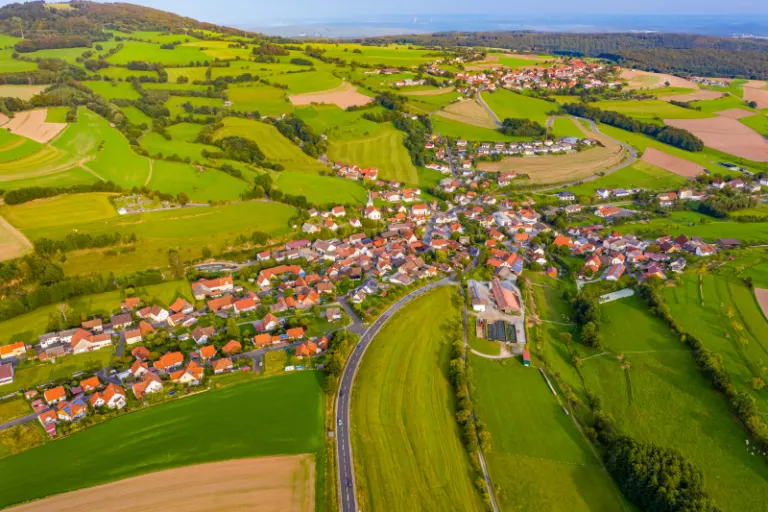


Geroda in the open Rhön landscape
The development of Geroda stretches between meadows and fields through a shallow valley. In the distance, wooded ridges complete the view. The warm green surrounding the red roofs makes the outskirts of the town stand out clearly even in a wider view.
Meadows as the frame of the village
If you want to find Geroda in a photo, you can start with the connected roof group. The meadows gradually dissolve this closed impression from the outside.
A village view needs a comprehensible starting point. This can be an intersection, a prominent group of houses or the end of a street. From there, the paths to the outskirts of town can be more easily followed in the image. When publishing for readers from outside, a brief location information in the caption helps. Resident viewers are often interested in another level. They are looking for the location of a house, the route of their route to school or a familiar open space between buildings.
Preserve open land in the picture
A meadow may look almost empty in a small preview. The larger view shows paths, individual shadows or transitions to neighboring properties. As a foreground, it creates distance before the view reaches the houses or the next slope. This distance is often an important part of the composition in landscape photos. If it is pruned too much, the development will appear denser. A deliberately wider section, on the other hand, shows what space the open land actually takes up.
Recognize the shape of the valley area
Two different narrative directions emerge along a valley and across it. The longitudinal view leads into the distance and shows what is arranged one behind the other. Looking sideways, the width of the valley floor and the rise on either side become clearer. Which view is convincing depends on the question asked of the image. For a description of the location, a lateral view is often productive. For a stretch along a route, the longitudinal view gives the viewer a direction to follow across multiple subjects.
The distribution of blue tones
Among the 4 photos in the gallery, shot 2 and shot 4 provide a good starting point for the comparison. In the first excerpt, shades of blue play a smaller role. In the second shot, blue areas take up more space. Blue can extend over a large contiguous area or only appear in individual parts. What also counts for the effect is whether these areas extend to the edge of the picture or surround the main subject.
The camera captured September 16, 2020 for shot 1 and shot 4. The time interval between these two views is approximately 2 minutes. The exposure time was 1/160 second for the first of the images mentioned and 1/200 second for the second.
A townscape for chronicle and community
For a local chronicle, the outer edge of the development is just as interesting as the middle. That's often where things change first. A meadow becomes a building site, a driveway is given a new route, a single house disappears behind the larger trees. If you want to talk about the same place again later, a dated overall view is helpful. You can agree with the aerial photographer on a point that should remain in the image when repeated. A street intersection is usually better suited for this than a moving object on the side of the road.
Related motifs in the aerial photo archive
Two further articles invite comparison. In the first, Obersinn, another detail is in the foreground. At Obersinn, the houses lie like a narrow band between meadows and wooded heights. Then Burkardroth is a good option. The aerial photos show the community of Burkardroth in the Rhön.