 F4LUFTBILDER
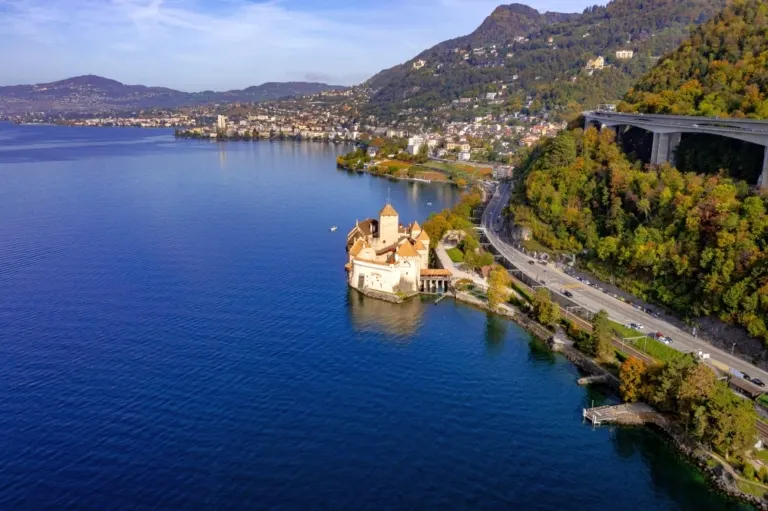


Chillon Castle in front of the lake shore
The walls of Chillon Castle come close to the waters of Lake Geneva. In the wide view there is only a narrow strip of shore between the castle and the mountain slope. A steeper perspective shows how close together towers, roofs and courtyards are in the available space.
A castle between hillside and water
At Chillon Castle, the outer walls are so close to Lake Geneva that their reflection can become part of the motif. From above, however, the narrow gap to the mainland is interesting. He explains the island location in much more detail than a close-up of battlements or roofing.
When looking at a castle, it is worth looking at the roofs and the spaces between them separately. A large roof wing initially attracts attention. In addition, a courtyard or a narrow passage can show much better how the parts of the system are connected. An oblique aerial photo also gives an idea of their altitude. With a narrower section, a piece of outer wall or slope maintains orientation and allows the building to remain visible in the context of its location.
The view over a calm body of water
On a lake, a large area can appear almost uniform. Only an arch on the bank, a boat or the reflection of a slope gives the eye something to hold on to. In aerial photography, the image often appears particularly spatial, as it contains a piece of land in the foreground in addition to the water. For a wide image, the water surface can have more space. In a narrow format, their connection to the shore should be retained so that the landscape becomes a recognizable place and not just any blue area.
Courtyards and entrances
In a courtyard, the relationships between buildings change. What appears from the outside to be a single long building can actually wrap around several open areas. In a steep aerial view, the passageways, the corners and the orientation of the adjacent roofs become understandable. For a caption, a specific reference to the visible side of the courtyard is often more helpful than a list of all the buildings. This means the viewer can recognize the spatial connection themselves and find it again in other images.
The distribution of blue tones
For a direct image comparison, use shot 7 and shot 4 from the gallery with 12 aerial photos. In the first excerpt, shades of blue play a smaller role. In the second shot, blue areas take up more space. Blue can extend over a large contiguous area or only appear in individual parts. What also counts for the effect is whether these areas extend to the edge of the picture or surround the main subject.
According to camera data, Shot 1 and Shot 12 were taken on October 29, 2022. There is a gap of around 5 minutes between the two images. The exposure time was 1/400 second for the first of the images mentioned and 1/320 second for the second.
Communicate architecture and location together
For a post about a building, two captions can fulfill very different tasks. The first names the system and explains its location, the second leads to a visible component. Historical construction phases or previous uses can hardly be determined from the roof color and current wall edges alone. However, an aerial photographer can show precisely which parts will actually be visible in the later photo. For a guide or local chronicler, this separation makes it easier to work with people who know the local building history.
Related motifs in the aerial photo archive
The article Hohenschwangau Castle offers another perspective. The yellow building of Hohenschwangau Castle stands out clearly from the darker forest in the aerial photo. In the gallery Poland – Marienburg there is a different focus. On the Nogat, Marienburg can be recognized by the extent of its red roofs.