 F4LUFTBILDER
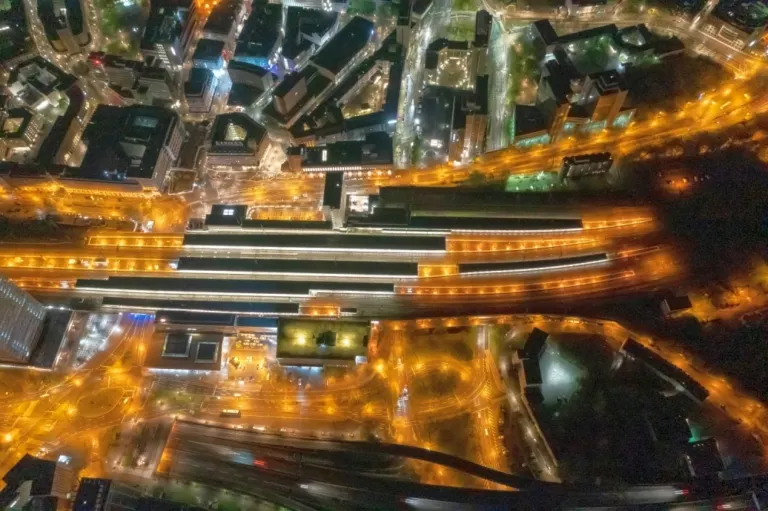


Around Essen Central Station at night
In Essen city center, the streets around the main train station glow in warm colors. From above, the large roof areas and the narrower street canyons can be seen at the same time. The deeper the view falls between the buildings, the more the facades appear next to the traffic network.
Eating in the light of the traffic axes
The Essen night shots use the lighting around the main station as orientation. A single bright building can draw the eye. The classified streets and tracks also explain which part of the city center it is in and from which direction it can be seen.
At night, light and dark surfaces tell a different story than during the day. Streets remain visible as lines, while green spaces and unlit facades recede. A bright spot easily attracts more attention than the intended subject. When it comes to publishing, it helps to take a look at the small preview. If the location is also recognizable at this scale, the recording works as an introduction. When viewed larger, the transitions between the warm light of the streets and the darker buildings can be seen.
The parallel lines of the tracks
Tracks guide the eye through the image over longer distances. Where several lines converge, an easily recognizable reference point is created. If you take a broader view, you will also see adjacent streets and houses. This shows how much space the railway system takes up within the town. A tighter neckline can focus on the repetition of lines. Both variants are interesting for a report about the location, as long as the caption makes it clear which section is actually visible.
The silhouette from a closer look
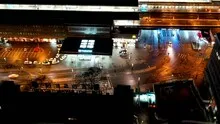
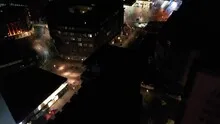
In tall buildings, the silhouette changes with every viewing angle. Two towers that stand close together from one direction reveal a wide gap from another perspective. In a shot for a city performance, such a gap helps to recognize individual buildings. A piece of surroundings at the foot of the houses is equally important. It shows how the large buildings arrive in the street space and what scale neighboring buildings, squares or traffic systems have in comparison.
Warm tones within the series
Among the 55 photos in the gallery, shot 41 and shot 36 provide a good starting point for the comparison. In the second view, warm reds and browns have more weight than in the first. Red-brown and yellowish areas are particularly noticeable next to cooler surfaces. What is interesting when comparing is whether they are concentrated on a single object or appear spread out across the entire view.
The camera captured April 22, 2023 for shot 1 and shot 55. The time interval between these two views is approximately 62 minutes. The exposure time was 1/4 second for the first of the images mentioned and 1/5 second for the second.
The Aerial Videos section supplements the photos with 2 clips. The aerial photographer's photographs linked there include “Food from the Air”. The relevant video page on Adobe Stock can be opened using the respective preview.
Maintain the lighting mood in the selection
In strong backlight or great darkness, outlines often take over the task that colors and materials do during the day. An edit for publication should first be checked to see whether these outlines are retained. On a bright screen, dark areas can still appear finely graduated, converging in a small print. The later use is therefore practical information for the aerial photographer. A test printout or a view in the intended screen size says more than simply assessing a greatly enlarged file.
More aerial photos for comparison
Two further articles invite comparison. In the first, Düsseldorf, a different detail is in the foreground. The Düsseldorf photographs focus on the main train station and its surroundings in the city structure at night. After that, Frankfurt am Main is a good option. Frankfurt at night first appears as a network of light.