 F4LUFTBILDER
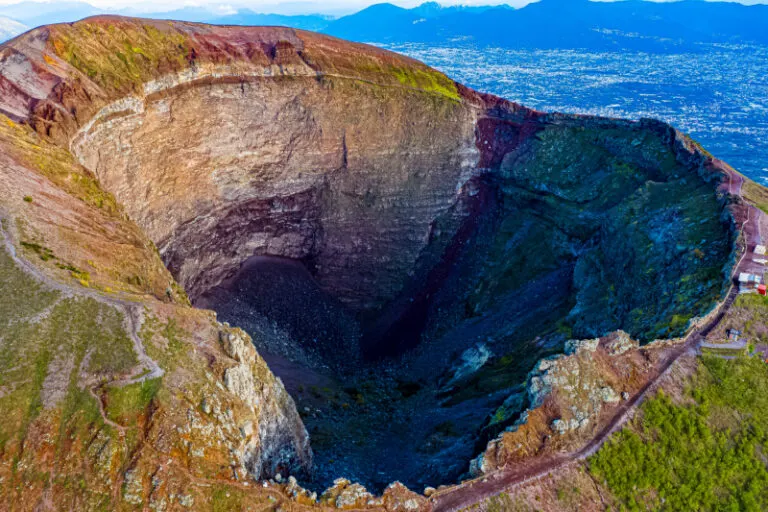


Vesuvius above its crater rim
At Vesuvius, the steep view over the edge captures the depth of the crater and its shape in one shot. The outside becomes flatter towards the surrounding area. When comparing the views, it becomes clear why a seemingly uniform cone hides a completely different landscape inside.
Inner wall and outer slope
On Vesuvius, the inner and outer slopes of the crater are two different motifs. The narrow edge between them shows in the aerial photo where the terrain changes direction.
A volcano can be read very differently from different distances. In the distance, its profile is the most striking shape. On the mountain itself, broken edges, colored rock surfaces and hollows replace the familiar silhouette. A sequence from both perspectives explains the connection. It is worth making an objective distinction between permanently visible terrain and what was accentuated by snow, clouds or light at the time the photo was taken. The activity of the mountain cannot be assessed from a single image.
The shape of the rock in the light
Rock surfaces are often harder to read in an aerial photograph than their sharp outline suggests. A dark area can be a deep crevice or just in shadow. The connection of several visible edges provides information. Where they converge and cover a surface, a spatial jump is understandable. A location with clear rock contours is suitable for publication with smaller images. In a larger format, the eye can wander more over the finer differences in the surface.
Shadow as an indication of height
In the aerial photo, a shadow lies next to the object that casts it. This makes it possible to perceive the approximate height of a shape in relation to its surroundings, even if its side surface is barely visible. The effect depends heavily on sunlight. When selecting a shot, you can therefore check whether the shadow explains a detail or obscures an important area. A second view from a different direction complements the image where the dark area has little detail.
Warm tones within the series
To switch between two of the 8 aerial photos, shot 7 and shot 5 can be called up directly in the gallery. In the second view, warm reds and browns have more weight than in the first. Red-brown and yellowish areas are particularly noticeable next to cooler surfaces. What is interesting when comparing is whether they are concentrated on a single object or appear spread out across the entire view.
Shot 1 and Shot 8 are views from November 1, 2019. According to the camera's time information, there are about 6 minutes between the two images. The exposure time was 1/50 second for the first of the images mentioned and 1/80 second for the second.
Show the proportions of the landscape
For a series of natural history images, an observable form is the best starting point. Where does a surface end, what structure continues next to it, and how much environment do you need to tell the two apart? The questions can be followed directly from the photo. Statements about origin, depth or age, however, require additional sources. An aerial photographer can capture the visible traces and draw attention to a detail. In the later caption you can then clearly explain what can be seen in the photo and what comes from the technical classification.
Related motifs in the aerial photo archive
Two additional views can be used in the archive for comparison. The first can be found under Volcano Osorno. In the distance, the snow-capped Osorno looms over the green of southern Chile. The second belongs to the article Valle de la Luna. In the Valle de la Luna in Chile, flat, light soils alternate with deep grooves.
Aerial photos of the Vesuvius volcano
Your aerial photographer across Europe
Request a free quote